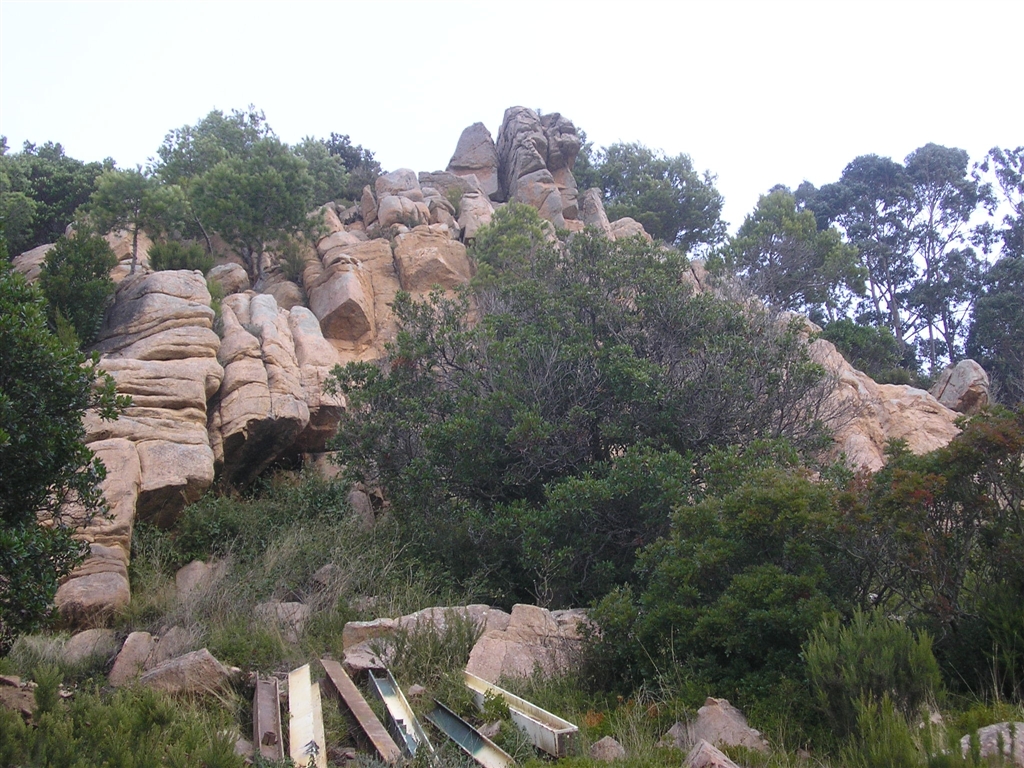
Costa Brava is one of the most beautiful seaside in the Mediterranean coast. Sea and mountains meet to paint an unique landscape... and to create big headaches to demolition contractors when they found granite near populated areas. It was the case in Aigua Xelida. Some granite rocks had to be demolished. Rocks were located in a hilly area, so the use of hydraulic breakers was impossible. And the location of the works near a residential zone prevented the contractor to obtain the licences to use explosives. In these situations, the features of CRAS, the non-explosive demolition mortar manufactured by Kayati SL, come to help demolition contractors.
CRAS is a powder, a mortar that performs demolition by Hydration, a principle well known since Antiquity: some products or items -like CRAS nowadays, or wooden wedges in the Ancient Egypt- expand in contact with water. It is a silent but emphatic strength, able to break the rocks, even the Costa Brava's granite.
The original rocks, to be demolished, can be seen in the first image of this article. The following pictures show how CRAS has been poured in the previously bored rocks, and how the non-
explosive demolition mortar has been cracking the granite. Perforations the key step in all the process, and the experience gained by Kayati SL in years of demolition works around the World is an added value for demolition contractors. In Aigua Xelida project, boring diameter was 30 mm, and distance between holes, 50 cm. Temperature is another factor to be taken into consideration in demolition projects with demolition mortars. Conventional products works well working in a narrow range of temperatures: a good product in summer is not working properly in winter.
Kayati SL manufactures CRAS UNIVERSAL, or “green CRAS”, fully operative all around the year. In Aigua Xelida, temperatures ranged fro 2ºC up to 10ºC, and the performances of CRAS UNIVERSAL were as good as in demolitions projects in Tropical regions.
After drilling, CRAS was poured in the holes, and began to work. In this project, CRAS was used to demolish the higher part of the rocks. Debris fell in the lower part of the premises, ready to be easily evacuated. Holes were loaded with CRAS at 10 am, and last images on this article were taken two days later, at 5 pm. In two days, demolition work was done.
No annoying noises, no vibrations, no flying particles, no security over costs... no to all of the troubles cause by the use of explosives, a solution not allowed in this case. In short, CRAS allowed a complete and safe demolition without the use of machinery and without the licenses for use of explosives.
For further information, please contact Kayati SL:
KAYATI SL
Magdalena, 14 - 5º B
E-01008 VITORIA-GASTEIZ
(SPAIN)
Phone: +34 945 135 626 Fax: +34 945 130 592
e-mail: kayati@kayati.com
www.kayati.com


+004.jpg)
+005.jpg)
+006.jpg)
+011.jpg)


+010.jpg)